Kingdom of Candia
Venetian overseas territory on Crete from 1205 to 1669.

Wikipedia / Wikimedia Commons
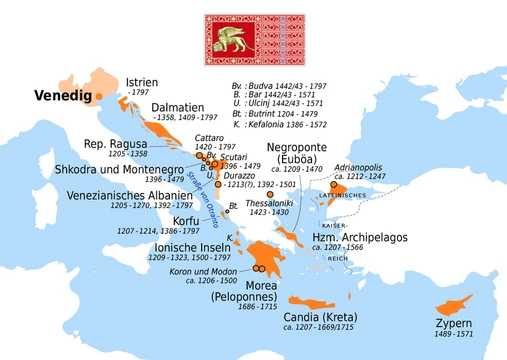
The Kingdom or Duchy of Candia was the official name of Crete during its period as an overseas territory of the Republic of Venice, from the Venetian conquest in 1205–1212 until the island's fall to the Ottoman Empire in the Cretan War (1645–1669). The island was commonly known as Candia after its capital, Candia or Chandax (modern Heraklion). In modern Greek historiography, this period is called the Venetocracy.
- born
- 1205–1212 (Venetian conquest)
- died
- 1669 (fall to Ottoman Empire; last outposts fell in 1715)
- field
- Venetian overseas territory
- nationality
- Republic of Venice
- known_for
- Venetian rule over Crete; center of the Cretan Renaissance; strategic Eastern Mediterranean possession
Lore & Background
The island of Crete had been part of the Byzantine Empire until 1204, when the Fourth Crusade dissolved the empire. Crete was initially allotted to Boniface of Montferrat, but he sold his rights to Venice. Venetian troops first occupied the island in 1205, but it took until 1212 to secure it, especially against opposition from Genoa. The colony was divided into six provinces (sestieri) named after the divisions of Venice itself, while the capital Candia was directly subjected to the Commune Veneciarum. In the early 14th century, this division was replaced by four provinces, almost identical to the modern prefectures. The islands of Tinos and Cythera also came under the kingdom's purview.
Reader's Guide
The Kingdom of Candia was Venice's major overseas possession for over four centuries, serving as a crucial base for eastern trade and the Balkan slave trade. During the first two centuries, revolts by the native Orthodox Greek population against Roman Catholic Venetians were frequent, with fourteen revolts counted between 1207 and the Revolt of St. Titus in the 1360s. Thereafter, despite occasional revolts and Turkish raids, the island largely prospered, and Venetian rule opened a window into the Italian Renaissance. This led to an artistic and literary revival unparalleled elsewhere in the Greek world: the Cretan School of painting, culminating in the works of El Greco, and a widespread literature in the local idiom, including the early 17th-century romances Erotokritos and Erophile. After the Ottoman conquest of Cyprus in 1571, Crete was Venice's last major overseas possession. The long and devastating Cretan War (1645–1669) ended with the fall of Candia in 1669; only the fortresses of Souda, Gramvousa, and Spinalonga remained Venetian until 1715.
Did You Know?
- The island was divided into six provinces (sestieri) named after the divisions of the city of Venice itself.
- Fourteen revolts are counted between 1207 and the Revolt of St. Titus in the 1360s.
- Venetian rule opened a window into the Italian Renaissance, leading to the Cretan School of painting and the works of El Greco.
- The last Venetian outposts on Crete—Souda, Gramvousa, and Spinalonga—fell to the Turks in 1715.
More in Stato da Màr 1-24
Spotted an error? Know more?
This is a living reference — every entry is fact-audited, and reader corrections feed straight into our audit queue. Suggest an edit · See this site's audit record