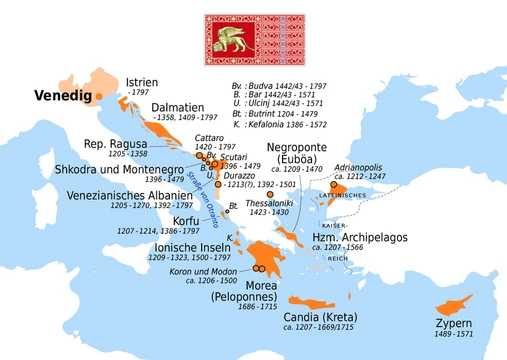
Venetian Istria
Venetian rule gradually integrated Istrian coastal cities into the Stato da Màr.

Wikipedia / Wikimedia Commons
Venetian Istria refers to the period of gradual integration of the coastal regions of the Istrian peninsula into the Venetian maritime state, the Stato da Màr. This process began under Doge Pietro II Candiano between 932 and 939, when coastal cities signed a first act of devotion to Venetian rule. Venetian influence in Istria was long and challenging, opposed by royal authorities, particularly after the restoration of the Holy Roman Empire in 962 and the placement of the Istrian county under the Duchy of Carinthia in 976. Two distinctive political influences thus emerged: Venetian in coastal regions and imperial in the Istrian hinterland.
- start_date
- 932–939
- key_figure
- Pietro II Candiano
- region
- Istrian coastal regions
- polity
- Venetian Stato da Màr
- opposing_power
- Holy Roman Empire / Duchy of Carinthia
- characteristic
- Dual political influence: Venetian coast vs. imperial hinterland
Lore & Background
Under Pietro II Candiano, Doge of Venice between 932 and 939, coastal cities of Istria signed a first act of devotion to Venetian rule, initiating a gradual integration into the Venetian Stato da Màr. This process was long and challenging, opposed by royal authorities, especially after the restoration of the Holy Roman Empire in 962 and the consequent placement of the Istrian county under the newly created Duchy of Carinthia in 976. Thus, two distinctive political influences were present in Istria: Venetian in coastal regions, and imperial in the Istrian hinterland.
Reader's Guide
The Venetian period in Istria established a lasting dual political structure that shaped the region for centuries. Venetian control over coastal cities fostered maritime trade and cultural ties with the Adriatic, while the imperial hinterland remained under different administrative influences. This division contributed to the complex ethnic and political landscape of Istria, which later became shared by Croatia, Slovenia, and Italy. The Venetian legacy is evident in the architecture and urban planning of coastal towns, though the source article does not detail specific buildings. The period also set the stage for later conflicts between Venetian and imperial interests in the region.
Did You Know?
- The process of Venetian integration began under Doge Pietro II Candiano between 932 and 939.
- Coastal cities of Istria signed a first act of devotion to Venetian rule, initiating integration into the Stato da Màr.
- After 962, the Istrian county was placed under the jurisdiction of the Duchy of Carinthia, opposing Venetian influence.
- Two distinctive political influences emerged: Venetian in coastal regions and imperial in the Istrian hinterland.
More in Stato da Màr 1-24
Spotted an error? Know more?
This is a living reference — every entry is fact-audited, and reader corrections feed straight into our audit queue. Suggest an edit · See this site's audit record