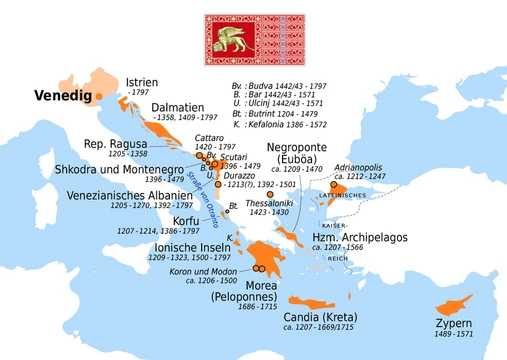
Stato da Màr
Venice's overseas empire, spanning the Mediterranean from 1000 to 1797.

Wikipedia / Wikimedia Commons
The Republic of Venice divided its holdings into three parts: the Dogado, or Venice itself; the Domini di Terraferma in northern Italy; and the Stato da Màr—also called the Domini da Mar, meaning "State of the Sea" or "Domains of the Sea." This maritime empire included the overseas territories Venice controlled from around the year 1000 until 1797. Over the centuries, these lands stretched across what are now Italy, Slovenia, Croatia, Montenegro, Albania, and Greece, with key regions such as Istria, Dalmatia, the Ionian Islands, the Peloponnese, Crete, the Cyclades, Euboea, and Cyprus.
Venice’s overseas expansion began around 1000, when Doge Pietro II Orseolo defeated the Narentines and secured recognition from Dalmatian city-states, allowing him to briefly claim the title "Duke of Dalmatia." Stable control over Dalmatia, however, did not come until the early 1400s. In the 12th and 13th centuries, Venice gradually took over Istria, holding it until the Republic’s end. The empire reached its largest nominal size after the Fourth Crusade in 1204, when Venice declared ownership of three-eighths of the Byzantine Empire. In practice, most of that territory was never actually governed by Venice, remaining under Greek Byzantine successor states like the Despotate of Epirus and the Empire of Nicaea. Venice did keep a strong presence in Constantinople, holding the influential post of Podestà until the Byzantines retook the city in 1261, and remained active in the region during the Frankokratia period. Of its gains from the Fourth Crusade, Venice held Euboea until the 1400s, the Cyclades until the 1500s, and Crete until the 1600s.
A new phase of growth followed the War of Chioggia in the late 1300s. Corfu came under permanent Venetian rule in 1386, followed by Argos and Nauplia in 1388–1394, the Adriatic ports of Durazzo and Alessio on the Albanian coast in 1392, Scutari in 1396, and Drivasto in 1397. The Battle of Ankara in 1402 temporarily slowed the Ottoman rise, while the death of Milan’s Duke Giangaleazzo Visconti created a power vacuum in northern Italy that allowed expansion of the Domini di Terraferma. The Ottoman Interregnum and the 1403 Treaty of Gallipoli boosted commerce and led Venice to acquire a string of Greek fortresses: Lepanto in 1407, Patras in 1408, Navarino in 1410, and Thessalonica temporarily in 1423. In Dalmatia, where Venice had lost its po
- field
- Maritime empire
- nationality
- Republic of Venice
- known_for
- Overseas territories and commercial/military leadership
- duration
- c. 1000 – 1797
- key_historian
- Fernand Braudel
Lore & Background
The creation of Venice's overseas empire began around the year 1000 with the defeat of the Narentines by Doge Pietro II Orseolo and recognition of Venetian rule by Dalmatian city-states, allowing the Doge to call himself 'Duke of Dalmatia' for the next few decades. Control over Dalmatia, however, would not be stabilized until the early 15th century. In the 12th and 13th centuries, Venice gradually established its rule over Istria, which lasted until the end of the Republic. Venice's overseas domains reached their greatest nominal extent at the conclusion of the Fourth Crusade in 1204, with declaration of the acquisition of three octaves of the Byzantine Empire, though most of this territory was never controlled by Venice, being held by Greek Byzantine successor states such as the Despotate of Epirus and the Empire of Nicaea.
Reader's Guide
The Stato da Màr played a critical role in Venice's commercial and military leadership, with overseas possessions—particularly islands such as Corfu, Crete, and Cyprus—described by historian Fernand Braudel as 'Venice's motionless fleet'. The empire's history is dominated by successive Ottoman–Venetian wars from the 15th century onward, leading to the loss of many territories but also occasional gains, such as the Peloponnese from the late 1680s to 1715 and the Dalmatian Hinterland in the 1680s. After 1715, the remaining overseas domains, kept until the Fall of the Republic of Venice to Napoleon I in 1797, were all in Istria, Dalmatia, and the Ionian Islands, with none left east of Kythira and Antikythera. The Venetian hold over navigation in the Adriatic Sea was maintained for centuries, to the extent that it was labeled 'Mare di Venezia' (sea of Venice) on maps of the seventeenth and eighteenth centuries.
Did You Know?
- The Stato da Màr was one of three subdivisions of the Republic of Venice's possessions, the other two being the Dogado and the Domini di Terraferma.
- Venice's overseas domains reached their greatest nominal extent at the conclusion of the Fourth Crusade in 1204.
- The Venetian hold over navigation in the Adriatic Sea was labeled 'Mare di Venezia' on maps of the 17th and 18th centuries.
- After 1715, the remaining overseas domains were all in Istria, Dalmatia, and the Ionian Islands.
More in Stato da Màr 1-24
Spotted an error? Know more?
This is a living reference — every entry is fact-audited, and reader corrections feed straight into our audit queue. Suggest an edit · See this site's audit record