Koroni
Historic fortress town on the Gulf of Messinia.
Koroni, also called Corone, is a town on the southwest peninsula of the Peloponnese in southern Greece, situated on a hill beneath a Venetian castle that reaches down to the Gulf of Messinia. Since a 2011 local government reform, it has been part of the municipality of Pylos-Nestor as a municipal unit. The town itself had a population of 1,193 in 2021, while the larger municipal unit—which includes the communities of Akritochori, Charakopio, Chrysokellaria, Falanthi, Kaplani, Kompoi, Koroni, Vasilitsi, Vounaria, and Iamia, plus the uninhabited island of Venétiko—covers 105 square kilometers and had 3,600 residents in the same census. It lies about 56 kilometers southwest of Kalamata by road.
The settlement dates back to ancient times. The 2nd-century Greek geographer Pausanias, in his work *Messeniaka*, placed the original Koroni at what is now Petalidi, a few kilometers north, and noted temples to Greek gods and a copper statue of Zeus there. Over the centuries, the town shifted to its present location, which was once the site of the ancient town of Asini. A Byzantine fortress was built there in the 6th and 7th centuries AD. Koroni first appears as a bishopric in the *Notitiae Episcopatuum* of Emperor Leo VI the Wise, listed as a suffragan of the See of Patras. Surviving seals record the names of several Greek bishops. The Greek eparchy was dissolved in the 19th century during an ecclesiastical reorganization after Greek independence.
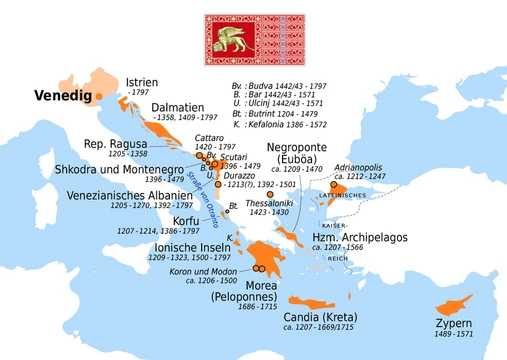
After the Fourth Crusade’s fall of Constantinople in 1204, the Partitio Romaniae assigned most of the Peloponnese to Venice, but the Franks under William of Champlitte quickly took control, founding the Principality of Achaea. Koroni’s fortress was initially given to Champlitte’s lieutenant, Geoffrey of Villehardouin. In 1206 or 1207, a Venetian fleet under Premarini and the son of Doge Enrico Dandolo seized the Messenian peninsula, including Koroni and neighboring Methoni, from Champlitte’s men. The Treaty of Sapienza in June 1209 recognized Venetian ownership of both fortresses. Venice held them for three centuries. Koroni and Methoni—called Coron and Modon—were the first Venetian possessions on the Greek mainland. A Venetian document described them as “the receptacle and special nest of all our galleys, ships, and vessels on their way to the Levant,” and their position controlling Levantine trade earned them the title “th
- location
- Southwest peninsula of the Peloponnese, Greece
- population
- 1,193 (town, 2021); 3,600 (municipal unit, 2021)
- area
- 105 km² (municipal unit)
- founded
- Ancient times
- known_for
- Venetian fortress, cochineal dye production, rocket launch site (1966–1989)
Lore & Background
The town was founded in ancient times. The 2nd-century geographer Pausanias reported its original location at modern Petalidi and noted temples of Greek gods and a copper statue of Zeus. The town later moved to its current location, where the ancient town of Asini once stood. In the 6th and 7th centuries AD, the Byzantines built a fortress there. It first appears as a bishopric in the Notitiae Episcopatuum of Emperor Leo VI the Wise.
After the Fourth Crusade, the Venetians took Koroni in 1206 or 1207, and it became one of their first possessions on the Greek mainland. For three centuries, Koroni and Methoni were vital Venetian outposts, described as 'the receptacle and special nest of all our galleys, ships, and vessels on their way to the Levant.' The town flourished as a waystation for merchants and pilgrims, and was famous for its cochineal dye and Venetian engineers' expertise in siege engines. The Venetians allowed Greek Orthodox bishops to reside alongside Catholic ones, though mistreatment of Greeks was reported in the later 14th century.
Koroni fell to the Ottomans in 1500, was briefly retaken by Andrea Doria in 1532, but surrendered again in 1534 after a siege by Hayreddin Barbarossa. It remained under Ottoman control until the Morean War, when the Venetians captured it in 1685. The Ottomans recaptured it in 1715. The town declined in the 18th century, and by 1805 its trade had stopped. It became part of the modern Greek state in 1828, liberated by French General Nicolas Joseph Maison.
Reader's Guide
Koroni's significance lies in its long history as a strategic maritime and military outpost, first under the Byzantines, then as a cornerstone of Venetian power in the eastern Mediterranean. For three centuries, it and Methoni were the 'chief eyes of the Republic,' controlling trade routes to the Levant and serving as a key stop for galleys, merchants, and pilgrims. The town's prosperity was tied to its cochineal dye industry and its engineers' military expertise. Its role as a Latin bishopric and later a Catholic titular see reflects its religious importance. The Ottoman period saw it as an administrative center, though its importance waned. In the 20th century, Koroni gained a brief modern role as a sounding rocket launch site between 1966 and 1989, with 371 rockets launched. Today, its Venetian castle and coastal setting make it a historical landmark in the Peloponnese.
Did You Know?
- Koroni was known as Corone by the Venetians and Ottomans.
- The town was a major producer of cochineal, used to make crimson dyes.
- Between 1966 and 1989, 371 sounding rockets were launched from a facility near Koroni.
- One of its Latin bishops, Angelo Correr, later became Pope Gregory XII.
More in Stato da Màr 1-24
Spotted an error? Know more?
This is a living reference — every entry is fact-audited, and reader corrections feed straight into our audit queue. Suggest an edit · See this site's audit record