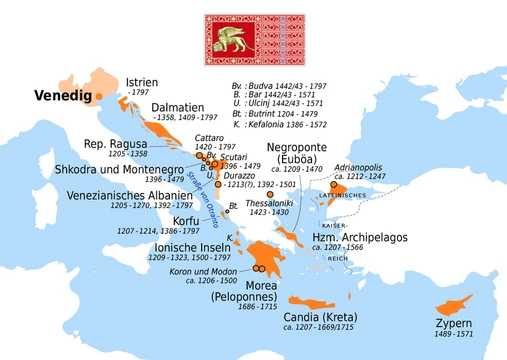
Venetian Cyprus
Venetian colony from 1489 to 1571, ended by Ottoman conquest.

Wikipedia / Wikimedia Commons
Venetian Cyprus refers to the period from 1489 to 1571 when the island of Cyprus was an overseas possession of the Republic of Venice. It began when the last Crusader state, the Kingdom of Cyprus, ended with the forced abdication of Queen Catherine Cornaro, and ended when the island was conquered by the Ottoman Empire. Venetian rule was marked by extensive fortification projects, commercial prosperity, and growing tension with the Ottoman Empire, culminating in a full-scale invasion and the fall of Famagusta in 1571.
- start_year
- 1489
- end_year
- 1571
- field
- Colonial administration and military defense
- nationality
- Venetian (Republic of Venice)
- known_for
- Fortification of Cyprus, rule through Queen Catherine Cornaro, and resistance during the Ottoman invasion
Lore & Background
Venice had sought control of Cyprus for centuries, with Venetian merchants active on the island from around 1000 AD. The acquisition was finalized in 1489 when Queen Catherine Cornaro, a Venetian noblewoman, was forced to abdicate and cede administration to Venice. She had become queen after the death of her husband James II of Cyprus and their infant son. As compensation, she retained the title of Queen and was made Sovereign Lady of Asolo in northern Italy. Venetian Cyprus was composed primarily of Greek Orthodox peasants, oppressed by the Latin ruling class, and Venice favored Catholicism, causing friction with local clergy.
Reader's Guide
Venetian Cyprus represents a significant chapter in the history of Venetian maritime expansion and the broader struggle between Christian Europe and the Ottoman Empire. The period is notable for the extensive military engineering projects that transformed Cypriot cities, reflecting the strategic importance Venice placed on the island as a military base. The fortifications of Nicosia and Kyrenia, though ultimately unable to stop the Ottoman invasion, demonstrate the advanced defensive thinking of the era. The siege of Famagusta, lasting 11 months against overwhelming odds, tied down Ottoman forces and contributed to the timing of the Battle of Lepanto in 1571, where the Holy League defeated the Ottoman fleet. The fall of Cyprus marked the end of Venetian rule and the beginning of Ottoman control, a transition that reshaped the island's demographics and culture. The period also provides the historical setting for Shakespeare's Othello, whose title character is a Venetian commander defending Cyprus. The legacy of Venetian Cyprus includes well-preserved fortifications, a mix of architectural styles, and a complex social history of Latin rulers and Greek Orthodox subjects.
Did You Know?
- Venetian merchants were active on Cyprus beginning around 1000 AD.
- Queen Catherine Cornaro was forced to abdicate on March 14, 1489, and was made Sovereign Lady of Asolo in northern Italy.
- The Venetian walls of Nicosia, built in 1567, had eleven bastions and three gates: Kyrenia, Paphos, and Famagusta.
- The siege of Famagusta lasted from September 1570 to August 1571, with Venetian defenders numbering about 8,500 men against over 200,000 Ottoman troops.
More in Stato da Màr 1-24
Spotted an error? Know more?
This is a living reference — every entry is fact-audited, and reader corrections feed straight into our audit queue. Suggest an edit · See this site's audit record