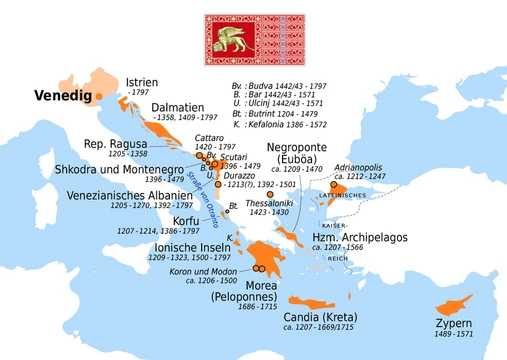
Kingdom of the Morea
Venetian-ruled Peloponnese, conquered 1685–99, lost 1715.
The Kingdom of the Morea was the official name given by the Republic of Venice to the Peloponnese peninsula in southern Greece after conquering it from the Ottoman Empire during the Morean War of 1684–99. The Venetians attempted to repopulate the region and revive its agriculture and economy, but failed to secure the territory militarily or win the allegiance of most of the population, leading to its recapture by the Ottomans in 1715.
- Existed
- 1688–1715
- Capital
- Nauplia
- Official Language
- Italian, Venetian, Greek
- Religion
- Roman Catholic (official), Greek Orthodox
- Government
- Venetian overseas territory under a Provveditore generale
- Historical Significance
- Last major Venetian territorial acquisition in Greece, lost after a brief Ottoman campaign
Lore & Background
The Kingdom of the Morea was established after Francesco Morosini led Venetian forces to seize the Peloponnese from the Ottomans between 1685 and 1687, aided by the local Greek population. The territory was formally organized in 1688 under Governor-General Giacomo Corner, who oversaw a committee that divided the peninsula into four provinces: Romania, Laconia, Messenia, and Achaia. Each province and district was headed by a provveditore combining civil and military authority, with a rector for justice and a chamberlain for finances. The islands of Kythera and Antikythera were also included in the administration.
Reader's Guide
The Kingdom of the Morea represents a significant but short-lived attempt by Venice to reassert its influence in Greece after the loss of Crete. The Venetians implemented ambitious repopulation and economic development policies, offering land grants to settlers from Attica, Crete, Chios, the Ionian Islands, and even some Bulgarians. They introduced new grape varieties, promoted silk and forestry, and established trade links with Ottoman Greece and North Africa. Annual revenue rose from 61,681 reales in 1684–85 to 500,501 in 1710. However, the regime failed to win popular loyalty; many peasants fled to Ottoman territories, and when the Ottomans returned in 1715, the bulk of the population offered little resistance. The period also saw the emergence of a new affluent class of merchants and landholders, which the historian Apostolos Vakalopoulos identified as the origin of the kodjabashis oligarchy that dominated the Peloponnese until the Greek War of Independence.
Did You Know?
- The population of the Morea in 1688 was only 86,468, down from an estimated pre-war 200,000.
- The Venetians introduced new grape varieties from France and Italy and levied an import tax on foreign wine.
- The annual revenue from the province rose from 61,681 reales in 1684–85 to 500,501 in 1710.
- The Ottoman government's pre-war tax revenue from the Morea is estimated at 1,699,000 reales.
More in Stato da Màr 1-24
Spotted an error? Know more?
This is a living reference — every entry is fact-audited, and reader corrections feed straight into our audit queue. Suggest an edit · See this site's audit record