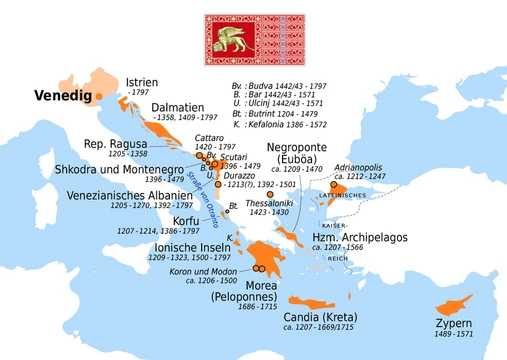
Sati (castle)
Medieval fortified town near Shkodër, razed after 1459.
Sati (Albanian: Shati; Latin: Satti) was a medieval fortified town located near Shkodër in present-day Albania. From 1395 to 1459, it was held by a succession of powers: the Venetian Republic, the Dukagjini family, the Ottoman Empire, and finally Skanderbeg, who demolished it after 1459.
Until 1395, Sati was part of the Lordship of Zeta, within the fief of Konstantin Balšić, who appointed Koja Zaharia as its castellan. That year, Balša II gave Sati, along with Scutari and Drivast, to Venice to create a buffer against the Ottomans. Koja Zaharia refused to hand over the town, declaring himself lord of Sati and Dagnum, and became an Ottoman vassal. Venice tried and failed to take Sati by force in 1396. A year later, they persuaded Koja to accept a Venetian citizen, Progon Dukagjin, as castellan. The Zaharia family kept control; Pjetër Zakaria served as bishop of Sati in 1417. After Koja’s death, his son Lekë Zaharia succeeded him.
Lekë Zaharia joined the League of Lezhë in 1444 but was killed that same year by his pronoiar, Nicholas Dukagjini. Skanderbeg asked Venice to grant him Lekë’s former pronoia, but Lekë’s mother Boša and the local population opposed the League and backed Venetian rule over Sati. Nicholas Dukagjini then seized Sati and nearby villages without resistance. By 1446, Venetian records called him a “former enemy.” After Venice recaptured Dagnum from Lekë Dukagjini in September 1457, the governor of Scutari gave the Zadrima region to Draga Dukagjin, claiming it belonged to Sati. Draga, upset by a Venetian treaty with Lekë and Pal Dukagjini, asked the Venetian Senate to confirm his rights to Sati. The Senate overruled the governor and did so on 11 September 1458.
In 1459, Skanderbeg took Sati from the Ottomans and handed it to Venice to secure good relations before sending troops to Italy to aid King Ferdinand. Under the treaty, Venice was required to raze the fortress and remove all building materials to prevent its reconstruction. Before Venice could take control, Skanderbeg captured Sati and its area, drove out Lekë Dukagjini, and destroyed the town.
- location
- Near Shkodër, contemporary Albania
- period
- Medieval
- first mentioned
- 1395
- razed
- After 1459
- controlled by
- Venetian Republic, Dukagjini family, Ottoman Empire, Skanderbeg
Lore & Background
Sati was part of the Lordship of Zeta until 1395, belonging to the fief of Konstantin Balšić, who appointed Koja Zaharia as castellan. In 1395 Balša II ceded Sati, along with Scutari and Drivast, to the Venetian Republic to create a buffer zone against the Ottoman Empire. Koja Zaharia refused to allow Venetians to take control, proclaiming himself lord of Sati and Dagnum, and became an Ottoman vassal. Venetians attempted to capture Sati by force in 1396 but failed; after a year they convinced Koja to allow Venetian citizen Progon Dukagjin as castellan.
The Zaharia family consolidated control; Pjetër Zakaria was bishop of Sati in 1417. After Koja's death, his son Lekë Zaharia succeeded him. Lekë was killed in 1444 by his pronoiar, Nicholas Dukagjini. Despite Skanderbeg's claims to Lekë's pronoia, Lekë's mother Boša and the population supported Venetian takeover. Nicholas Dukagjin captured Sati without a fight, and in 1446 appears in Venetian archives as a 'former enemy'. In 1458 the Venetian Senate confirmed Draga Dukagjin's rights over Sati. In 1459 Skanderbeg's forces captured Sati from the Ottoman Empire, ceded it to Venice, and then destroyed it.
Reader's Guide
Sati's significance lies in its role as a contested fortress in the shifting power dynamics of late medieval Albania. Its control passed among the Venetian Republic, the Dukagjini family, the Ottoman Empire, and Skanderbeg, reflecting the broader struggle for dominance in the region. The fortress was ultimately razed by Skanderbeg after 1459 as part of a treaty with Venice to secure Venetian support for his Italian campaign. The site illustrates the complex feudal loyalties and local resistance to external powers, as seen in Koja Zaharia's refusal to yield to Venice and the population's preference for Venetian rule over Skanderbeg's League of Lezhë. Its destruction prevented future military use, marking the end of its strategic importance.
Did You Know?
- Koja Zaharia refused to allow Venetians to take control of Sati in 1395 and proclaimed himself lord of Sati and Dagnum.
- Pjetër Zakaria, a member of the Zaharia family, was bishop of Sati in 1417.
- Skanderbeg captured Sati from the Ottoman Empire in 1459 and then destroyed it.
- The Venetian Senate confirmed Draga Dukagjin's rights over Sati on 11 September 1458.
More in Stato da Màr 1-24
Spotted an error? Know more?
This is a living reference — every entry is fact-audited, and reader corrections feed straight into our audit queue. Suggest an edit · See this site's audit record