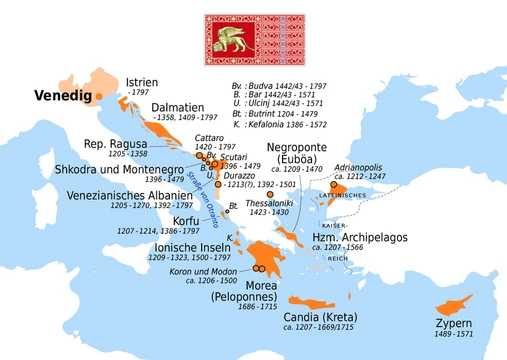
Triarchy of Negroponte
A Lombard crusader state on Euboea under Venetian influence.
The Triarchy of Negroponte was a crusader state on the island of Euboea, known to the Venetians as Negroponte, created after the Fourth Crusade carved up the Byzantine Empire. The island was split into three baronies, or *terzieri* ("thirds"): Chalkis, Karystos, and Oreos. A handful of interconnected Lombard families ran these territories, but the Republic of Venice soon came to dominate the island. By around 1390, it had become a regular Venetian colony, called the Realm of Negroponte.
After the Fourth Crusade, the *Partitio terrarum imperii Romaniae* awarded Euboea to Boniface of Montferrat, King of Thessalonica. He gave the island as a fief to the Flemish noble Jacques II of Avesnes, who fortified the capital, Chalkis. When Jacques died in mid-1205, the island passed to three Veronese barons: Ravano dalle Carceri, Giberto dalle Carceri, and Pecoraro da Mercanuovo. They split Euboea into three triarchies: the north, based at Oreos; the south, ruled from Karystos; and the center, governed from Chalkis. However, the city of Chalkis itself—called the "city of the Lombards"—was not under the central triarch’s control; it served as the island’s capital and a shared residence for the Lombard rulers and their families. By 1209, Ravano had made himself sole master of Euboea, styling himself *dominus insulae Nigropontis*. After backing a failed Lombard rebellion against the Latin Emperor, Henry of Flanders, Ravano sought a powerful protector. In March 1209, he signed an alliance with Venice, recognizing Venetian overlordship and granting the Venetians major commercial privileges. That same May, in a political balancing act, he also acknowledged his vassalage to the Latin Empire.
After Ravano died in 1216, his heirs quarreled over the succession, allowing the Venetian *bailo* to step in as mediator. He split each of the three baronies in two, creating six hexarchies (*sestieri*). The northern triarchy of Oreos went to Ravano’s nephews, Marino I and Rizzardo. The southern triarchy of Karystos was divided between his widow, Isabella, and his daughter, Bertha. The central triarchy was split between Giberto’s heirs, Guglielmo I and Alberto. It was also decreed that if a hexarch died, his share would pass to the other hexarch of that same triarchy, not to his own children. In practice, most *sestieri* were succeeded by brothers, sons, or nephews, keeping the baronies w
- Founded
- 1205
- Capital
- Chalkis (Negroponte)
- Type
- Crusader state / Triarchy
- Ruling families
- Lombard (dalle Carceri, da Mercanuovo, Ghisi, etc.)
- Major power influence
- Republic of Venice
- End of rule
- 1470 (Ottoman conquest)
Lore & Background
According to the division of Byzantine territory (the Partitio terrarum imperii Romaniae), Euboea was awarded to Boniface of Montferrat, King of Thessalonica. Boniface ceded the island as a fief to the Flemish noble Jacques II of Avesnes, who fortified the capital Chalkis. After his death in mid-1205, the island was ceded to three Veronese barons: Ravano dalle Carceri, Giberto dalle Carceri, and Pecoraro da Mercanuovo. They divided the island into three triarchies: the northern based at Oreos, the southern ruled from Karystos, and the central portion ruled from Chalkis. By 1209, Ravano had established himself as sole master of Euboea, styling himself as dominus insulae Nigropontis. He signed an alliance with Venice in March 1209, recognizing Venetian overlordship and granting commercial privileges, while also acknowledging vassalage to the Latin Empire.
Reader's Guide
The Triarchy of Negroponte represents a distinctive example of fragmented crusader governance in the aftermath of the Fourth Crusade. Its division into three baronies, later subdivided into six hexarchies after succession disputes, illustrates the complex feudal and familial politics of Frankish Greece. The island's gradual absorption into the Venetian colonial system—culminating in its transformation into the Realm of Negroponte circa 1390—highlights Venice's strategic and commercial interests in the Aegean. The triarchy's history includes the War of the Euboeote Succession (1255–1262), involving the Principality of Achaea and Venice, and a Byzantine interlude under the renegade Licario, who reconquered most of Euboea except Chalkis. The triarchy ended with the Ottoman conquest of Chalkis on 12 July 1470, an event commemorated in Rossini's opera Maometto II.
Did You Know?
- The triarchy was divided into three baronies (terzieri) named after the towns of Chalkis, Karystos, and Oreos.
- After Ravano dalle Carceri's death in 1216, the three baronies were split into six hexarchies (sestieri) to resolve succession disputes.
- The War of the Euboeote Succession (1255–1262) involved the Principality of Achaea and Venice, ending with a treaty recognizing William II of Villehardouin's suzerainty.
- The Byzantine renegade Licario, based near Karystos, conquered most of Euboea except Chalkis under Emperor Michael VIII Palaeologus.
More in Stato da Màr 1-24
Spotted an error? Know more?
This is a living reference — every entry is fact-audited, and reader corrections feed straight into our audit queue. Suggest an edit · See this site's audit record