Venetian Albania
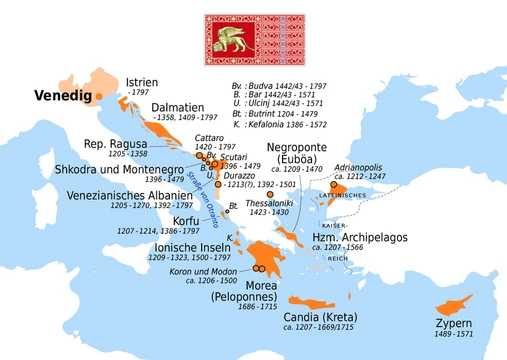
Venetian possessions in the southeastern Adriatic, centered on the Bay of Kotor.
Venetian Albania (Venetian: Albania vèneta, Italian: Albania Veneta) was the official term for several possessions of the Republic of Venice in the southeastern Adriatic, encompassing coastal territories primarily in present-day southern Montenegro and partially in northern Albania. The term was used from 1392 until the fall of the Republic of Venice in 1797, designating Venetian holdings that stretched from the southern borders of the Republic of Ragusa to Durrës in coastal Albania, generally extending no more than 20 km inland. After the loss of northern Albanian territories to the Ottoman Empire by the end of the 15th century, the name was retained for the remaining possessions centered around the Bay of Kotor.
- Existed
- 1392–1797
- Region
- Southeastern Adriatic (present-day southern Montenegro and northern Albania)
- Capital
- Cattaro (Kotor)
- Language
- Venetian (urban), Serbo-Croatian (inland), Albanian (border areas)
- Government
- Province of the Republic of Venice
- Historical era
- Late Middle Ages / Early Modern period
- Treaty ending
- Treaty of Campo Formio (1797)
Lore & Background
During the Renaissance, Venetian Albania was relatively rich, and the area around Kotor enjoyed significant cultural and artistic development. The population of Christian Slavs in Dalmatia increased greatly as the Ottoman Empire conquered the Balkans in the 15th century. By the end of the 17th century, according to Oscar Randi, the Romance-speaking population had become a minority. Albanian piracy flourished during this period. The Venetian territories around Kotor lasted from 1420 to 1797, when the Republic of Venice fell and the region was transferred to the Habsburg monarchy by the Treaty of Campo Formio.
Reader's Guide
Venetian Albania represents a significant but often overlooked chapter in the history of the Venetian maritime empire (Stato da Màr). Its importance lies in its role as a strategic coastal buffer zone between Venetian Dalmatia and the expanding Ottoman Empire, and as a center of trade, shipbuilding, and culture, particularly in the Bay of Kotor. The towns of Cattaro (Kotor), Perast, and Budva (Budua) developed distinctive Venetian architecture and urban character, with Kotor later becoming a UNESCO World Heritage site. The demographic legacy is notable: urban areas were predominantly Venetian-speaking (about 66% according to Luigi Paulucci), while inland areas were mostly Serbo-Croatian-speaking, and near the Albanian border there were large Albanian-speaking communities. After the end of Venetian rule, the Italian-speaking population in the region declined sharply due to political changes and assimilation, from 32% in Cattaro in 1880 to 13.6% in 1910. Today, about 500 Italian speakers remain in Montenegro, mainly in the Kotor area, forming the Italian National Community of Montenegro.
Did You Know?
- Venetian Albania was officially used as a term even after most of its original Albanian territories were lost to the Ottoman Empire, referring only to the remaining coastal Montenegro possessions.
- The town of Perast, once part of Venetian Albania, had four active shipyards and a fleet of around a hundred ships in the 18th century.
- According to historian Luigi Paulucci, about 66% of the urban population around the Bay of Kotor spoke Venetian during Venetian rule.
- The Treaty of Campo Formio (1797) transferred Venetian Albania to the Habsburg monarchy after the fall of the Republic of Venice.
More in Stato da Màr 1-24
Spotted an error? Know more?
This is a living reference — every entry is fact-audited, and reader corrections feed straight into our audit queue. Suggest an edit · See this site's audit record