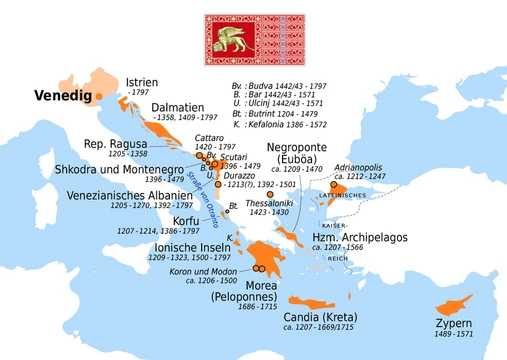
Venetian rule in the Ionian Islands
Venetian rule over the Ionian Islands lasted from the 14th century to 1797.
The Republic of Venice held the Ionian Islands as an overseas territory from the mid-1300s until the late 1700s, acquiring them piece by piece. The process started indirectly with Cythera and the small islet of Anticythera in 1238, becoming direct control after 1363. In 1386, Corfu’s ruling council voted to make the island a Venetian vassal, and that council remained the most powerful local body throughout the Venetian period. Venice then took Zante in 1485, Cephalonia in 1500, and Ithaca in 1503—each modeled its administration on Corfu’s and formed its own council. The final addition was Lefkada, captured in 1718. All these islands stayed part of Venice’s maritime empire, the Stato da Màr, until Napoleon dissolved the republic in 1797. Lying off western Greece in the Ionian Sea, Cythera is the southernmost, near the Peloponnese’s tip, while Corfu sits at the Adriatic’s entrance. The Venetian era is thought to have been broadly prosperous, especially compared to the Tourkokratia—Turkish rule over the rest of mainland Greece.
The islands’ governor was the Provveditore generale da Mar, based on Corfu. Each island’s authorities split into Venetian and local branches. The economy relied on exporting raisins, olive oil, and wine, and the Venetian lira served as the currency. Venetian cultural traits seeped into local music, cuisine, and language, leaving a lasting mark.
- start_of_venetian_rule
- mid-14th century
- end_of_venetian_rule
- 1797
- first_island_acquired
- Cythera (indirectly 1238, directly after 1363)
- last_island_acquired
- Lefkada (1718)
- governor_title
- Provveditore generale da Mar
- currency
- Venetian lira
- primary_exports
- raisins, olive oil, wine
Lore & Background
The Ionian Islands were an overseas possession of the Republic of Venice from the mid-14th century until the late 18th century. The conquest of the islands took place gradually. The first to be acquired was Cythera and the neighboring islet of Anticythera, indirectly in 1238 and directly after 1363. In 1386 the Council of Corfu, which was the governing body of the island, voted to make Corfu a vassal of Venice. During the Venetian period the Council remained the most powerful institution on the island. A century later, Venice captured Zante in 1485, Cephalonia in 1500 and Ithaca in 1503. These three islands modelled their administration on Corfu's model and formed their own councils. The conquest was completed in 1718 with the capture of Lefkada.
Reader's Guide
The Venetian period on the Ionian Islands is believed to have been generally prosperous, especially compared with the coinciding Tourkokratia—Turkish rule over the remainder of present-day Greece. The governor of the Ionian Islands during the Venetian period was the Provveditore generale da Mar, who resided on Corfu. Additionally, each island's authorities were divided into the Venetian and the domestic authorities. The economy of the islands was based on exporting local goods, primarily raisins, olive oil and wine, whereas Venetian lira, the currency of Venice, was also the currency of the islands. Some features of the culture of Venice were incorporated in the culture of the Ionian Islands, thus influencing to this day local music, cuisine and language. The islands remained part of the Venetian Stato da Màr until Napoleon Bonaparte dissolved the Republic of Venice in 1797.
Did You Know?
- Cythera and Anticythera were the first Ionian Islands acquired by Venice, indirectly in 1238 and directly after 1363.
- The Council of Corfu voted to make Corfu a vassal of Venice in 1386.
- The governor of the Ionian Islands was the Provveditore generale da Mar, who resided on Corfu.
- The Venetian lira was the currency used on the Ionian Islands during Venetian rule.
More in Stato da Màr 1-24
Spotted an error? Know more?
This is a living reference — every entry is fact-audited, and reader corrections feed straight into our audit queue. Suggest an edit · See this site's audit record